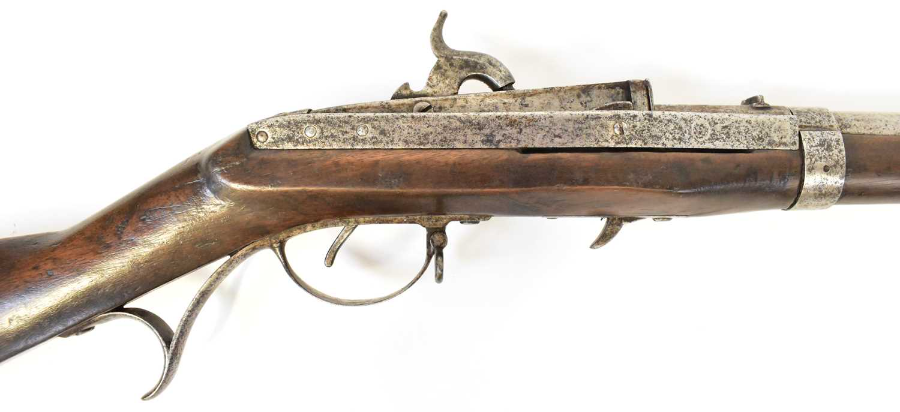
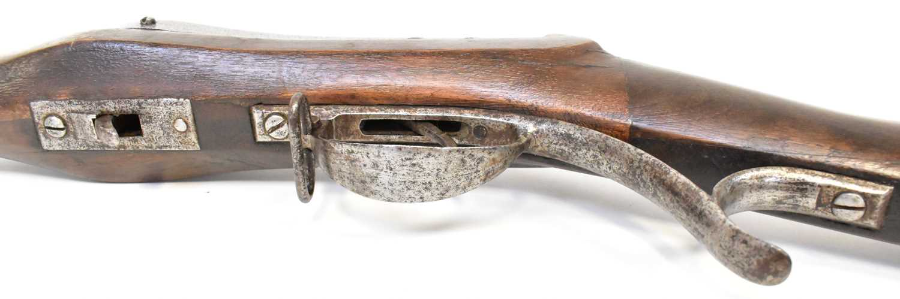
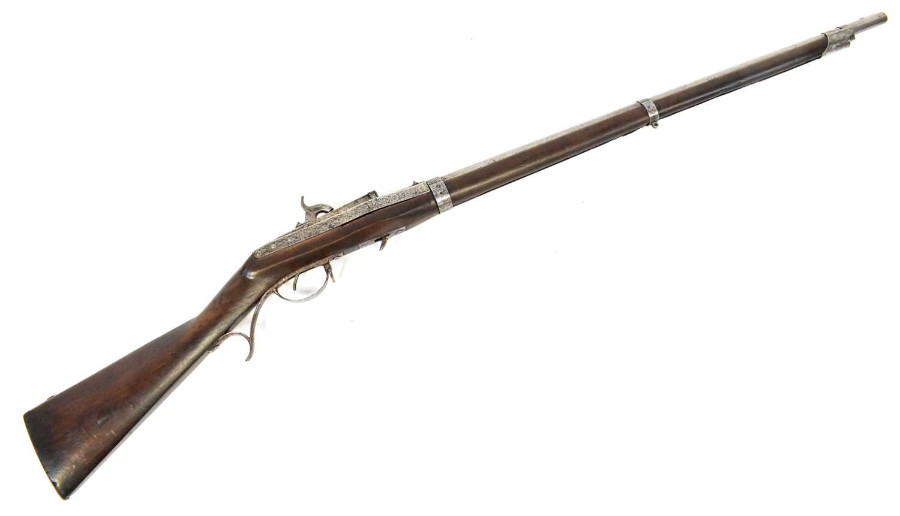
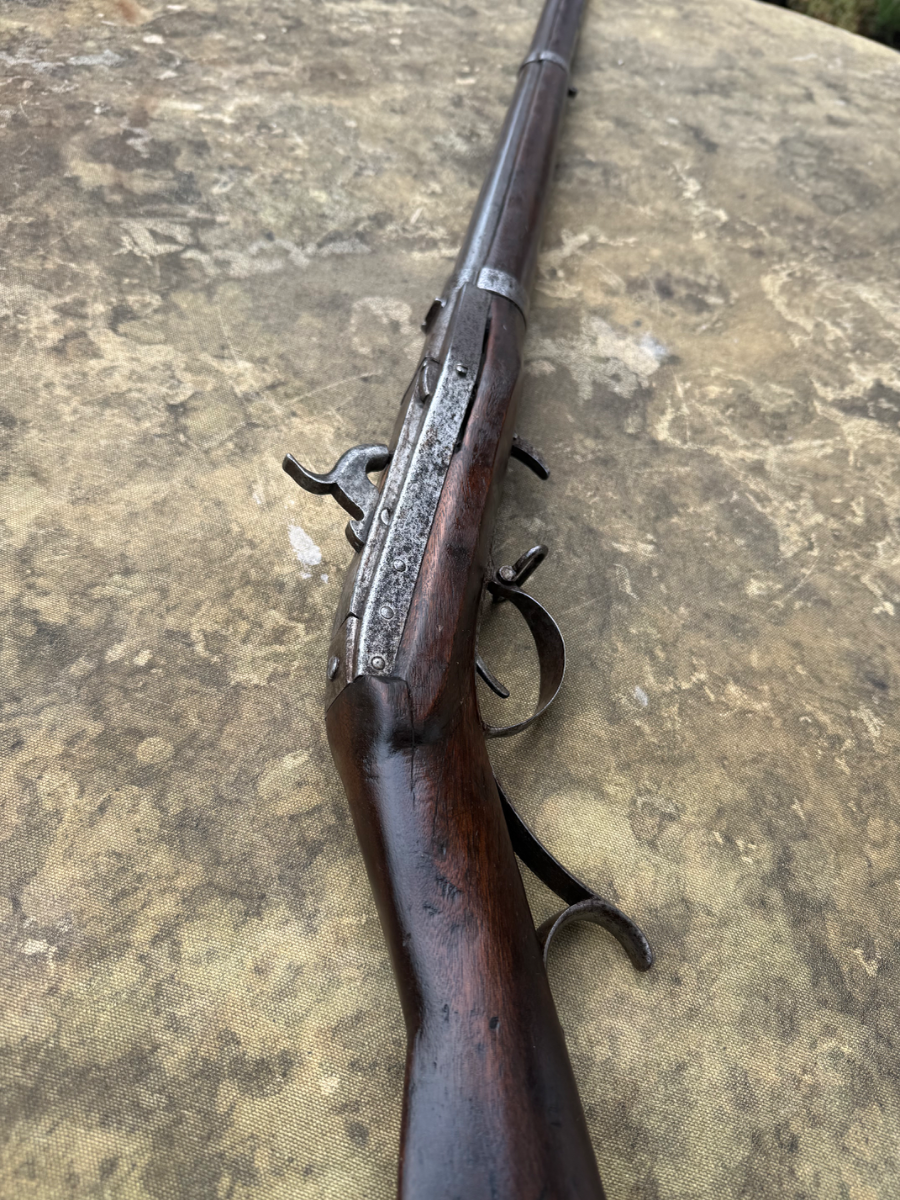
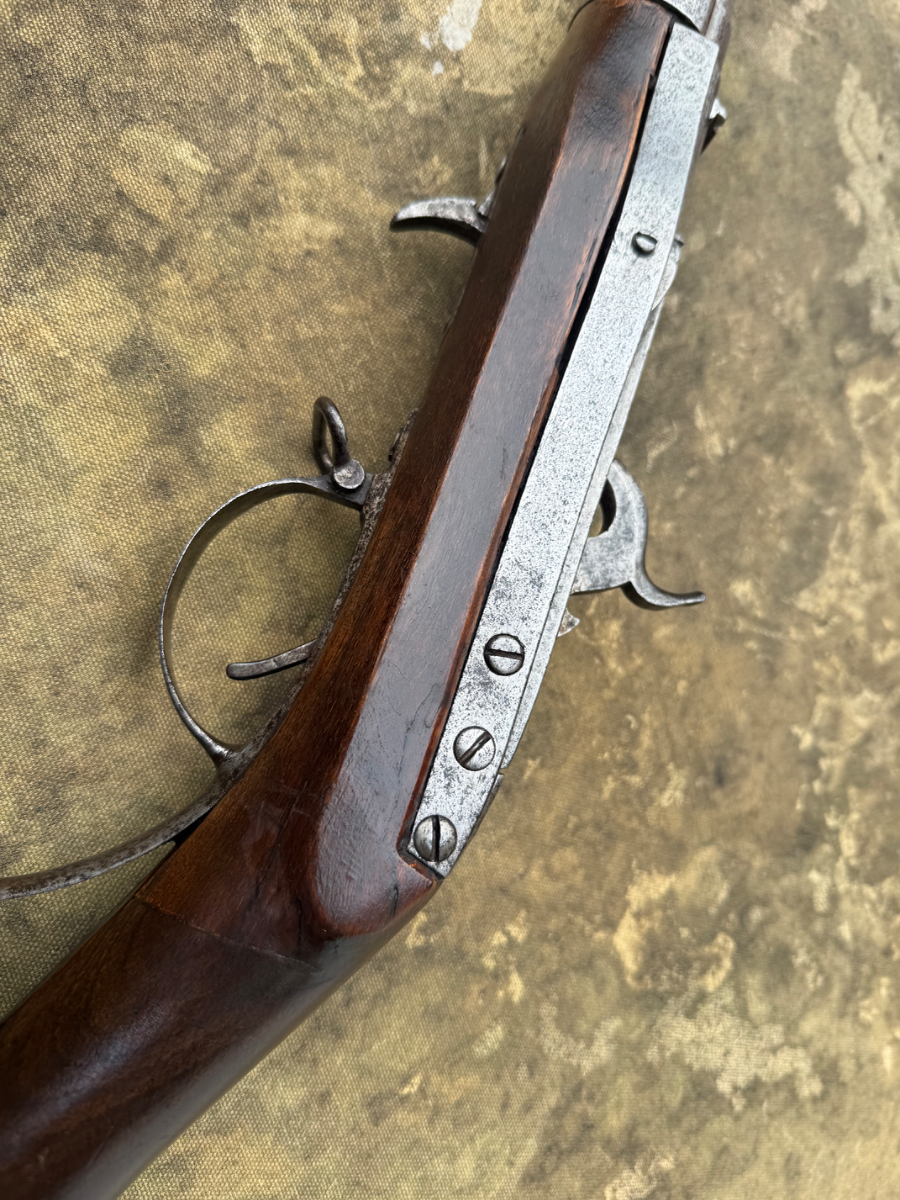
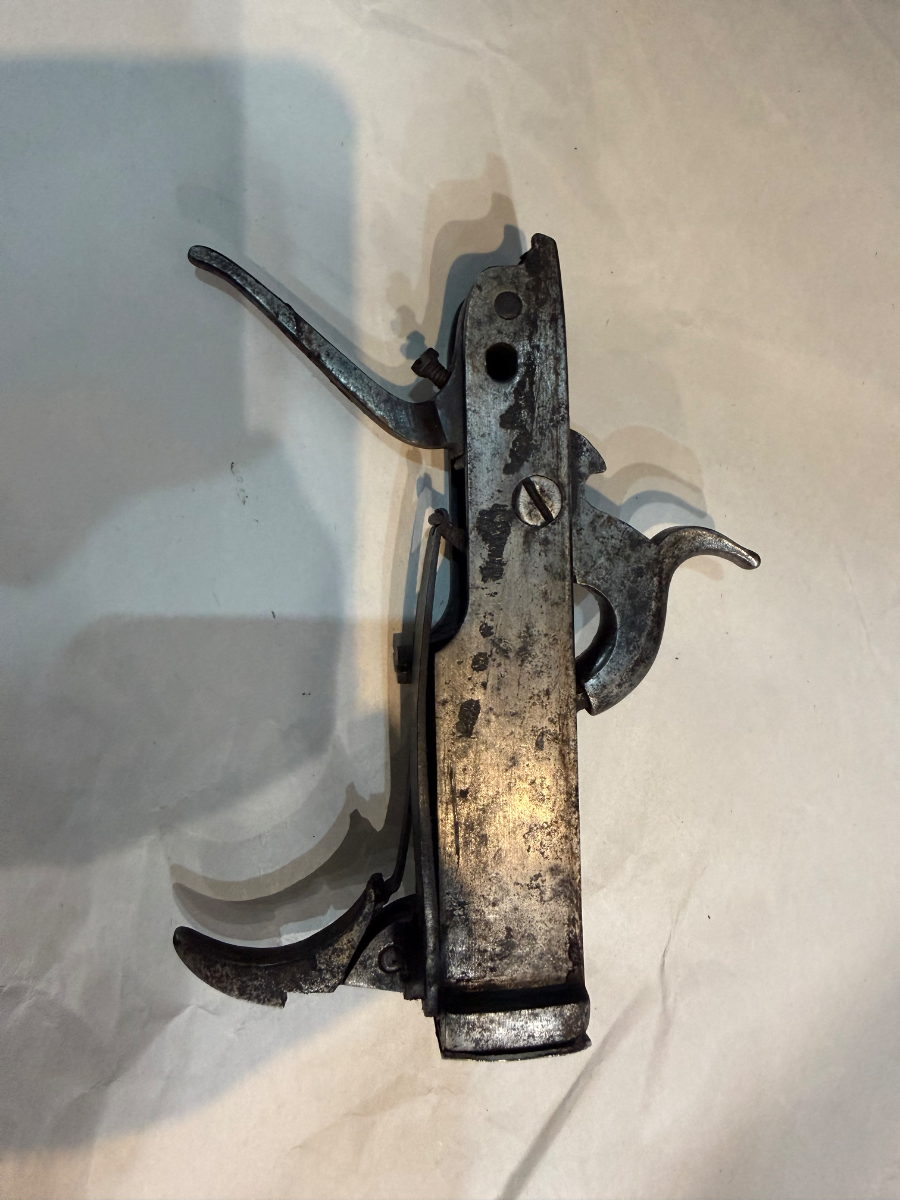
![A very rare U.S. Model 1819 Hall rifle, converted from flintlock to percussion while retaining its original full-length configuration. Overall length: 53¾". The original markings are worn and no longer visible. The rifle is in good overall condition; the breech mechanism opens properly, and the hammer holds securely at both half- and full-cock.
Hall Model 1819 Breechloading Rifle — History
On January 10, 1817, the U.S. Ordnance Department made the radical and unprecedented decision to purchase 100 of John H. Hall’s patented breechloading rifles. Hall had received his patent for a breechloading flintlock rifle on May 21, 1811. His innovative design employed a tilting breechblock containing both the centrally mounted flintlock mechanism and the chamber. Pressing a lever beneath the rifle allowed the front of the breechblock to tilt upward so that powder and ball could be loaded directly into the chamber. The block was then lowered back into position, aligning the chamber with the barrel.
The Hall rifle represented an important departure from conventional American military arms. At the time, the standard infantry long arm was the smoothbore musket, while rifles were generally reserved for specialist troops. Hall rifles were initially intended for such specialized use, but it was subsequently decided that they could also be issued to the “Light Companies” of infantry regiments. These companies commonly performed skirmishing duties and usually occupied the flanks of the line of battle.
Hall rifles were manufactured at Harpers Ferry Armory in approximately 1817, 1819, 1824–1826, and continuously from 1827 to 1840, with total production estimated at 19,780 rifles. Their markings changed during the production period. First-production rifles are generally marked on the breech in four lines:
J.H. HALL / H. FERRY / 1824 / U.S.
Second-production rifles, dated 1826–1838, are marked:
J.H. HALL / H. FERRY / U.S. / [date]
Third-production rifles, dated 1837–1840, are marked:
J.H. HALL / U.S. / [date]
Depending upon configuration and production period, the rifles generally weigh between 9 lbs. 12 oz. and 10 lbs. 4 oz.
The Hall rifle saw increasing military use during the 1830s. By April 1832, it had been decided to arm much of the 6th U.S. Infantry with Hall rifles, and the regiment employed them effectively during the Black Hawk War that year. The rifle also became particularly popular with state militias. Under the Militia Act of 1808, large quantities were distributed to the states, including nearly 2,500 during 1836 alone.
At least 18,940 Hall and contract-made Model 1819 rifles were eventually distributed to various states in lieu of their militia quotas. By 1855, states reporting Hall rifles in their inventories included Alabama, Arkansas, Delaware, Florida, Illinois, Indiana, Kentucky, Maine, Maryland, Massachusetts, Michigan, Mississippi, Missouri, New Hampshire, New Jersey, North Carolina, Pennsylvania, Tennessee, and Virginia.
The Hall rifle remained in considerable numbers when the Civil War began in 1861. Federal arsenals located in Alabama, Arkansas, Virginia, South Carolina, Georgia, and Louisiana reported a combined 10,229 Hall rifles on hand. The majority of these arms subsequently fell into Confederate possession when Southern arsenals and armories were seized.
Mississippi alone possessed more than 1,300 Hall rifles at the outbreak of the war following the transfer of 1,000 rifles from Baton Rouge. Confederate troops from Mississippi, Arkansas, and Tennessee are known to have carried flintlock Hall rifles as late as April 1862. Hall rifles had therefore remained in active service for decades after their introduction. Even in 1864, the Federal Washington Arsenal reported 97 flintlock Hall rifles remaining in storage.
Percussion Conversions
With the notable exception of a single Hall rifle reportedly converted to percussion at the Mount Vernon Arsenal in Alabama in 1864, Hall rifles were not systematically converted to percussion in Federal arsenals before the Civil War. During the war, however, substantial numbers were altered from their original flintlock configuration.
Federal workers ultimately converted at least 5,000 Hall rifles to percussion. Because the government regarded them as fourth-class arms by this period, relatively few of these converted rifles appear to have been issued for active service.
The U.S. Ordnance Department also purchased an additional 1,575 Hall rifles that had been privately converted to percussion during 1861. These rifles were sent to the Washington Arsenal but apparently were never issued.
There is anecdotal evidence that Berdan’s U.S. Sharpshooters possessed a small number of Hall rifles while stationed in Washington, D.C., during the autumn of 1861, although they appear to have disposed of them before departing for the front.
Individual states also undertook their own conversion programs. New Hampshire issued 300 converted Hall rifles to its 3rd Infantry Regiment. Mississippi converted approximately 1,000 Hall rifles during July 1861. Toward the end of that year, North Carolina converted 448 Hall rifles to percussion and shortened their barrels for cavalry use; an additional 70 rifles were converted without having their barrels shortened.
Consequently, the Hall rifle had an unusually long military life. Introduced as an innovative flintlock breechloader during an era dominated by muzzleloading muskets, it served in the Black Hawk War, was distributed extensively to state militias, and remained available in sufficient numbers to see service on both sides during the American Civil War. Its distinctive breechloading mechanism and lengthy service history make the Hall one of the most significant early American military firearms.](https://raven-yard-antiques.s3-accelerate.amazonaws.com/uploads/Halls-1819-Percussion-Rifle-16a82e4e1be9e3aws.jpg)
![A very rare U.S. Model 1819 Hall rifle, converted from flintlock to percussion while retaining its original full-length configuration. Overall length: 53¾". The original markings are worn and no longer visible. The rifle is in good overall condition; the breech mechanism opens properly, and the hammer holds securely at both half- and full-cock.
Hall Model 1819 Breechloading Rifle — History
On January 10, 1817, the U.S. Ordnance Department made the radical and unprecedented decision to purchase 100 of John H. Hall’s patented breechloading rifles. Hall had received his patent for a breechloading flintlock rifle on May 21, 1811. His innovative design employed a tilting breechblock containing both the centrally mounted flintlock mechanism and the chamber. Pressing a lever beneath the rifle allowed the front of the breechblock to tilt upward so that powder and ball could be loaded directly into the chamber. The block was then lowered back into position, aligning the chamber with the barrel.
The Hall rifle represented an important departure from conventional American military arms. At the time, the standard infantry long arm was the smoothbore musket, while rifles were generally reserved for specialist troops. Hall rifles were initially intended for such specialized use, but it was subsequently decided that they could also be issued to the “Light Companies” of infantry regiments. These companies commonly performed skirmishing duties and usually occupied the flanks of the line of battle.
Hall rifles were manufactured at Harpers Ferry Armory in approximately 1817, 1819, 1824–1826, and continuously from 1827 to 1840, with total production estimated at 19,780 rifles. Their markings changed during the production period. First-production rifles are generally marked on the breech in four lines:
J.H. HALL / H. FERRY / 1824 / U.S.
Second-production rifles, dated 1826–1838, are marked:
J.H. HALL / H. FERRY / U.S. / [date]
Third-production rifles, dated 1837–1840, are marked:
J.H. HALL / U.S. / [date]
Depending upon configuration and production period, the rifles generally weigh between 9 lbs. 12 oz. and 10 lbs. 4 oz.
The Hall rifle saw increasing military use during the 1830s. By April 1832, it had been decided to arm much of the 6th U.S. Infantry with Hall rifles, and the regiment employed them effectively during the Black Hawk War that year. The rifle also became particularly popular with state militias. Under the Militia Act of 1808, large quantities were distributed to the states, including nearly 2,500 during 1836 alone.
At least 18,940 Hall and contract-made Model 1819 rifles were eventually distributed to various states in lieu of their militia quotas. By 1855, states reporting Hall rifles in their inventories included Alabama, Arkansas, Delaware, Florida, Illinois, Indiana, Kentucky, Maine, Maryland, Massachusetts, Michigan, Mississippi, Missouri, New Hampshire, New Jersey, North Carolina, Pennsylvania, Tennessee, and Virginia.
The Hall rifle remained in considerable numbers when the Civil War began in 1861. Federal arsenals located in Alabama, Arkansas, Virginia, South Carolina, Georgia, and Louisiana reported a combined 10,229 Hall rifles on hand. The majority of these arms subsequently fell into Confederate possession when Southern arsenals and armories were seized.
Mississippi alone possessed more than 1,300 Hall rifles at the outbreak of the war following the transfer of 1,000 rifles from Baton Rouge. Confederate troops from Mississippi, Arkansas, and Tennessee are known to have carried flintlock Hall rifles as late as April 1862. Hall rifles had therefore remained in active service for decades after their introduction. Even in 1864, the Federal Washington Arsenal reported 97 flintlock Hall rifles remaining in storage.
Percussion Conversions
With the notable exception of a single Hall rifle reportedly converted to percussion at the Mount Vernon Arsenal in Alabama in 1864, Hall rifles were not systematically converted to percussion in Federal arsenals before the Civil War. During the war, however, substantial numbers were altered from their original flintlock configuration.
Federal workers ultimately converted at least 5,000 Hall rifles to percussion. Because the government regarded them as fourth-class arms by this period, relatively few of these converted rifles appear to have been issued for active service.
The U.S. Ordnance Department also purchased an additional 1,575 Hall rifles that had been privately converted to percussion during 1861. These rifles were sent to the Washington Arsenal but apparently were never issued.
There is anecdotal evidence that Berdan’s U.S. Sharpshooters possessed a small number of Hall rifles while stationed in Washington, D.C., during the autumn of 1861, although they appear to have disposed of them before departing for the front.
Individual states also undertook their own conversion programs. New Hampshire issued 300 converted Hall rifles to its 3rd Infantry Regiment. Mississippi converted approximately 1,000 Hall rifles during July 1861. Toward the end of that year, North Carolina converted 448 Hall rifles to percussion and shortened their barrels for cavalry use; an additional 70 rifles were converted without having their barrels shortened.
Consequently, the Hall rifle had an unusually long military life. Introduced as an innovative flintlock breechloader during an era dominated by muzzleloading muskets, it served in the Black Hawk War, was distributed extensively to state militias, and remained available in sufficient numbers to see service on both sides during the American Civil War. Its distinctive breechloading mechanism and lengthy service history make the Hall one of the most significant early American military firearms.](https://raven-yard-antiques.s3-accelerate.amazonaws.com/uploads/Halls-1819-Percussion-Rifle-16a82e4e65a131aws.jpg)
![A very rare U.S. Model 1819 Hall rifle, converted from flintlock to percussion while retaining its original full-length configuration. Overall length: 53¾". The original markings are worn and no longer visible. The rifle is in good overall condition; the breech mechanism opens properly, and the hammer holds securely at both half- and full-cock.
Hall Model 1819 Breechloading Rifle — History
On January 10, 1817, the U.S. Ordnance Department made the radical and unprecedented decision to purchase 100 of John H. Hall’s patented breechloading rifles. Hall had received his patent for a breechloading flintlock rifle on May 21, 1811. His innovative design employed a tilting breechblock containing both the centrally mounted flintlock mechanism and the chamber. Pressing a lever beneath the rifle allowed the front of the breechblock to tilt upward so that powder and ball could be loaded directly into the chamber. The block was then lowered back into position, aligning the chamber with the barrel.
The Hall rifle represented an important departure from conventional American military arms. At the time, the standard infantry long arm was the smoothbore musket, while rifles were generally reserved for specialist troops. Hall rifles were initially intended for such specialized use, but it was subsequently decided that they could also be issued to the “Light Companies” of infantry regiments. These companies commonly performed skirmishing duties and usually occupied the flanks of the line of battle.
Hall rifles were manufactured at Harpers Ferry Armory in approximately 1817, 1819, 1824–1826, and continuously from 1827 to 1840, with total production estimated at 19,780 rifles. Their markings changed during the production period. First-production rifles are generally marked on the breech in four lines:
J.H. HALL / H. FERRY / 1824 / U.S.
Second-production rifles, dated 1826–1838, are marked:
J.H. HALL / H. FERRY / U.S. / [date]
Third-production rifles, dated 1837–1840, are marked:
J.H. HALL / U.S. / [date]
Depending upon configuration and production period, the rifles generally weigh between 9 lbs. 12 oz. and 10 lbs. 4 oz.
The Hall rifle saw increasing military use during the 1830s. By April 1832, it had been decided to arm much of the 6th U.S. Infantry with Hall rifles, and the regiment employed them effectively during the Black Hawk War that year. The rifle also became particularly popular with state militias. Under the Militia Act of 1808, large quantities were distributed to the states, including nearly 2,500 during 1836 alone.
At least 18,940 Hall and contract-made Model 1819 rifles were eventually distributed to various states in lieu of their militia quotas. By 1855, states reporting Hall rifles in their inventories included Alabama, Arkansas, Delaware, Florida, Illinois, Indiana, Kentucky, Maine, Maryland, Massachusetts, Michigan, Mississippi, Missouri, New Hampshire, New Jersey, North Carolina, Pennsylvania, Tennessee, and Virginia.
The Hall rifle remained in considerable numbers when the Civil War began in 1861. Federal arsenals located in Alabama, Arkansas, Virginia, South Carolina, Georgia, and Louisiana reported a combined 10,229 Hall rifles on hand. The majority of these arms subsequently fell into Confederate possession when Southern arsenals and armories were seized.
Mississippi alone possessed more than 1,300 Hall rifles at the outbreak of the war following the transfer of 1,000 rifles from Baton Rouge. Confederate troops from Mississippi, Arkansas, and Tennessee are known to have carried flintlock Hall rifles as late as April 1862. Hall rifles had therefore remained in active service for decades after their introduction. Even in 1864, the Federal Washington Arsenal reported 97 flintlock Hall rifles remaining in storage.
Percussion Conversions
With the notable exception of a single Hall rifle reportedly converted to percussion at the Mount Vernon Arsenal in Alabama in 1864, Hall rifles were not systematically converted to percussion in Federal arsenals before the Civil War. During the war, however, substantial numbers were altered from their original flintlock configuration.
Federal workers ultimately converted at least 5,000 Hall rifles to percussion. Because the government regarded them as fourth-class arms by this period, relatively few of these converted rifles appear to have been issued for active service.
The U.S. Ordnance Department also purchased an additional 1,575 Hall rifles that had been privately converted to percussion during 1861. These rifles were sent to the Washington Arsenal but apparently were never issued.
There is anecdotal evidence that Berdan’s U.S. Sharpshooters possessed a small number of Hall rifles while stationed in Washington, D.C., during the autumn of 1861, although they appear to have disposed of them before departing for the front.
Individual states also undertook their own conversion programs. New Hampshire issued 300 converted Hall rifles to its 3rd Infantry Regiment. Mississippi converted approximately 1,000 Hall rifles during July 1861. Toward the end of that year, North Carolina converted 448 Hall rifles to percussion and shortened their barrels for cavalry use; an additional 70 rifles were converted without having their barrels shortened.
Consequently, the Hall rifle had an unusually long military life. Introduced as an innovative flintlock breechloader during an era dominated by muzzleloading muskets, it served in the Black Hawk War, was distributed extensively to state militias, and remained available in sufficient numbers to see service on both sides during the American Civil War. Its distinctive breechloading mechanism and lengthy service history make the Hall one of the most significant early American military firearms.](https://raven-yard-antiques.s3-accelerate.amazonaws.com/uploads/Halls-1819-Percussion-Rifle-16a82e4e9c93edaws.jpg)
![A very rare U.S. Model 1819 Hall rifle, converted from flintlock to percussion while retaining its original full-length configuration. Overall length: 53¾". The original markings are worn and no longer visible. The rifle is in good overall condition; the breech mechanism opens properly, and the hammer holds securely at both half- and full-cock.
Hall Model 1819 Breechloading Rifle — History
On January 10, 1817, the U.S. Ordnance Department made the radical and unprecedented decision to purchase 100 of John H. Hall’s patented breechloading rifles. Hall had received his patent for a breechloading flintlock rifle on May 21, 1811. His innovative design employed a tilting breechblock containing both the centrally mounted flintlock mechanism and the chamber. Pressing a lever beneath the rifle allowed the front of the breechblock to tilt upward so that powder and ball could be loaded directly into the chamber. The block was then lowered back into position, aligning the chamber with the barrel.
The Hall rifle represented an important departure from conventional American military arms. At the time, the standard infantry long arm was the smoothbore musket, while rifles were generally reserved for specialist troops. Hall rifles were initially intended for such specialized use, but it was subsequently decided that they could also be issued to the “Light Companies” of infantry regiments. These companies commonly performed skirmishing duties and usually occupied the flanks of the line of battle.
Hall rifles were manufactured at Harpers Ferry Armory in approximately 1817, 1819, 1824–1826, and continuously from 1827 to 1840, with total production estimated at 19,780 rifles. Their markings changed during the production period. First-production rifles are generally marked on the breech in four lines:
J.H. HALL / H. FERRY / 1824 / U.S.
Second-production rifles, dated 1826–1838, are marked:
J.H. HALL / H. FERRY / U.S. / [date]
Third-production rifles, dated 1837–1840, are marked:
J.H. HALL / U.S. / [date]
Depending upon configuration and production period, the rifles generally weigh between 9 lbs. 12 oz. and 10 lbs. 4 oz.
The Hall rifle saw increasing military use during the 1830s. By April 1832, it had been decided to arm much of the 6th U.S. Infantry with Hall rifles, and the regiment employed them effectively during the Black Hawk War that year. The rifle also became particularly popular with state militias. Under the Militia Act of 1808, large quantities were distributed to the states, including nearly 2,500 during 1836 alone.
At least 18,940 Hall and contract-made Model 1819 rifles were eventually distributed to various states in lieu of their militia quotas. By 1855, states reporting Hall rifles in their inventories included Alabama, Arkansas, Delaware, Florida, Illinois, Indiana, Kentucky, Maine, Maryland, Massachusetts, Michigan, Mississippi, Missouri, New Hampshire, New Jersey, North Carolina, Pennsylvania, Tennessee, and Virginia.
The Hall rifle remained in considerable numbers when the Civil War began in 1861. Federal arsenals located in Alabama, Arkansas, Virginia, South Carolina, Georgia, and Louisiana reported a combined 10,229 Hall rifles on hand. The majority of these arms subsequently fell into Confederate possession when Southern arsenals and armories were seized.
Mississippi alone possessed more than 1,300 Hall rifles at the outbreak of the war following the transfer of 1,000 rifles from Baton Rouge. Confederate troops from Mississippi, Arkansas, and Tennessee are known to have carried flintlock Hall rifles as late as April 1862. Hall rifles had therefore remained in active service for decades after their introduction. Even in 1864, the Federal Washington Arsenal reported 97 flintlock Hall rifles remaining in storage.
Percussion Conversions
With the notable exception of a single Hall rifle reportedly converted to percussion at the Mount Vernon Arsenal in Alabama in 1864, Hall rifles were not systematically converted to percussion in Federal arsenals before the Civil War. During the war, however, substantial numbers were altered from their original flintlock configuration.
Federal workers ultimately converted at least 5,000 Hall rifles to percussion. Because the government regarded them as fourth-class arms by this period, relatively few of these converted rifles appear to have been issued for active service.
The U.S. Ordnance Department also purchased an additional 1,575 Hall rifles that had been privately converted to percussion during 1861. These rifles were sent to the Washington Arsenal but apparently were never issued.
There is anecdotal evidence that Berdan’s U.S. Sharpshooters possessed a small number of Hall rifles while stationed in Washington, D.C., during the autumn of 1861, although they appear to have disposed of them before departing for the front.
Individual states also undertook their own conversion programs. New Hampshire issued 300 converted Hall rifles to its 3rd Infantry Regiment. Mississippi converted approximately 1,000 Hall rifles during July 1861. Toward the end of that year, North Carolina converted 448 Hall rifles to percussion and shortened their barrels for cavalry use; an additional 70 rifles were converted without having their barrels shortened.
Consequently, the Hall rifle had an unusually long military life. Introduced as an innovative flintlock breechloader during an era dominated by muzzleloading muskets, it served in the Black Hawk War, was distributed extensively to state militias, and remained available in sufficient numbers to see service on both sides during the American Civil War. Its distinctive breechloading mechanism and lengthy service history make the Hall one of the most significant early American military firearms.](https://raven-yard-antiques.s3-accelerate.amazonaws.com/uploads/Halls-1819-Percussion-Rifle-16a8341180d56aaws.jpg)
![A very rare U.S. Model 1819 Hall rifle, converted from flintlock to percussion while retaining its original full-length configuration. Overall length: 53¾". The original markings are worn and no longer visible. The rifle is in good overall condition; the breech mechanism opens properly, and the hammer holds securely at both half- and full-cock.
Hall Model 1819 Breechloading Rifle — History
On January 10, 1817, the U.S. Ordnance Department made the radical and unprecedented decision to purchase 100 of John H. Hall’s patented breechloading rifles. Hall had received his patent for a breechloading flintlock rifle on May 21, 1811. His innovative design employed a tilting breechblock containing both the centrally mounted flintlock mechanism and the chamber. Pressing a lever beneath the rifle allowed the front of the breechblock to tilt upward so that powder and ball could be loaded directly into the chamber. The block was then lowered back into position, aligning the chamber with the barrel.
The Hall rifle represented an important departure from conventional American military arms. At the time, the standard infantry long arm was the smoothbore musket, while rifles were generally reserved for specialist troops. Hall rifles were initially intended for such specialized use, but it was subsequently decided that they could also be issued to the “Light Companies” of infantry regiments. These companies commonly performed skirmishing duties and usually occupied the flanks of the line of battle.
Hall rifles were manufactured at Harpers Ferry Armory in approximately 1817, 1819, 1824–1826, and continuously from 1827 to 1840, with total production estimated at 19,780 rifles. Their markings changed during the production period. First-production rifles are generally marked on the breech in four lines:
J.H. HALL / H. FERRY / 1824 / U.S.
Second-production rifles, dated 1826–1838, are marked:
J.H. HALL / H. FERRY / U.S. / [date]
Third-production rifles, dated 1837–1840, are marked:
J.H. HALL / U.S. / [date]
Depending upon configuration and production period, the rifles generally weigh between 9 lbs. 12 oz. and 10 lbs. 4 oz.
The Hall rifle saw increasing military use during the 1830s. By April 1832, it had been decided to arm much of the 6th U.S. Infantry with Hall rifles, and the regiment employed them effectively during the Black Hawk War that year. The rifle also became particularly popular with state militias. Under the Militia Act of 1808, large quantities were distributed to the states, including nearly 2,500 during 1836 alone.
At least 18,940 Hall and contract-made Model 1819 rifles were eventually distributed to various states in lieu of their militia quotas. By 1855, states reporting Hall rifles in their inventories included Alabama, Arkansas, Delaware, Florida, Illinois, Indiana, Kentucky, Maine, Maryland, Massachusetts, Michigan, Mississippi, Missouri, New Hampshire, New Jersey, North Carolina, Pennsylvania, Tennessee, and Virginia.
The Hall rifle remained in considerable numbers when the Civil War began in 1861. Federal arsenals located in Alabama, Arkansas, Virginia, South Carolina, Georgia, and Louisiana reported a combined 10,229 Hall rifles on hand. The majority of these arms subsequently fell into Confederate possession when Southern arsenals and armories were seized.
Mississippi alone possessed more than 1,300 Hall rifles at the outbreak of the war following the transfer of 1,000 rifles from Baton Rouge. Confederate troops from Mississippi, Arkansas, and Tennessee are known to have carried flintlock Hall rifles as late as April 1862. Hall rifles had therefore remained in active service for decades after their introduction. Even in 1864, the Federal Washington Arsenal reported 97 flintlock Hall rifles remaining in storage.
Percussion Conversions
With the notable exception of a single Hall rifle reportedly converted to percussion at the Mount Vernon Arsenal in Alabama in 1864, Hall rifles were not systematically converted to percussion in Federal arsenals before the Civil War. During the war, however, substantial numbers were altered from their original flintlock configuration.
Federal workers ultimately converted at least 5,000 Hall rifles to percussion. Because the government regarded them as fourth-class arms by this period, relatively few of these converted rifles appear to have been issued for active service.
The U.S. Ordnance Department also purchased an additional 1,575 Hall rifles that had been privately converted to percussion during 1861. These rifles were sent to the Washington Arsenal but apparently were never issued.
There is anecdotal evidence that Berdan’s U.S. Sharpshooters possessed a small number of Hall rifles while stationed in Washington, D.C., during the autumn of 1861, although they appear to have disposed of them before departing for the front.
Individual states also undertook their own conversion programs. New Hampshire issued 300 converted Hall rifles to its 3rd Infantry Regiment. Mississippi converted approximately 1,000 Hall rifles during July 1861. Toward the end of that year, North Carolina converted 448 Hall rifles to percussion and shortened their barrels for cavalry use; an additional 70 rifles were converted without having their barrels shortened.
Consequently, the Hall rifle had an unusually long military life. Introduced as an innovative flintlock breechloader during an era dominated by muzzleloading muskets, it served in the Black Hawk War, was distributed extensively to state militias, and remained available in sufficient numbers to see service on both sides during the American Civil War. Its distinctive breechloading mechanism and lengthy service history make the Hall one of the most significant early American military firearms.](https://raven-yard-antiques.s3-accelerate.amazonaws.com/uploads/Halls-1819-Percussion-Rifle-16a83411e5ca89aws.jpg)
![A very rare U.S. Model 1819 Hall rifle, converted from flintlock to percussion while retaining its original full-length configuration. Overall length: 53¾". The original markings are worn and no longer visible. The rifle is in good overall condition; the breech mechanism opens properly, and the hammer holds securely at both half- and full-cock.
Hall Model 1819 Breechloading Rifle — History
On January 10, 1817, the U.S. Ordnance Department made the radical and unprecedented decision to purchase 100 of John H. Hall’s patented breechloading rifles. Hall had received his patent for a breechloading flintlock rifle on May 21, 1811. His innovative design employed a tilting breechblock containing both the centrally mounted flintlock mechanism and the chamber. Pressing a lever beneath the rifle allowed the front of the breechblock to tilt upward so that powder and ball could be loaded directly into the chamber. The block was then lowered back into position, aligning the chamber with the barrel.
The Hall rifle represented an important departure from conventional American military arms. At the time, the standard infantry long arm was the smoothbore musket, while rifles were generally reserved for specialist troops. Hall rifles were initially intended for such specialized use, but it was subsequently decided that they could also be issued to the “Light Companies” of infantry regiments. These companies commonly performed skirmishing duties and usually occupied the flanks of the line of battle.
Hall rifles were manufactured at Harpers Ferry Armory in approximately 1817, 1819, 1824–1826, and continuously from 1827 to 1840, with total production estimated at 19,780 rifles. Their markings changed during the production period. First-production rifles are generally marked on the breech in four lines:
J.H. HALL / H. FERRY / 1824 / U.S.
Second-production rifles, dated 1826–1838, are marked:
J.H. HALL / H. FERRY / U.S. / [date]
Third-production rifles, dated 1837–1840, are marked:
J.H. HALL / U.S. / [date]
Depending upon configuration and production period, the rifles generally weigh between 9 lbs. 12 oz. and 10 lbs. 4 oz.
The Hall rifle saw increasing military use during the 1830s. By April 1832, it had been decided to arm much of the 6th U.S. Infantry with Hall rifles, and the regiment employed them effectively during the Black Hawk War that year. The rifle also became particularly popular with state militias. Under the Militia Act of 1808, large quantities were distributed to the states, including nearly 2,500 during 1836 alone.
At least 18,940 Hall and contract-made Model 1819 rifles were eventually distributed to various states in lieu of their militia quotas. By 1855, states reporting Hall rifles in their inventories included Alabama, Arkansas, Delaware, Florida, Illinois, Indiana, Kentucky, Maine, Maryland, Massachusetts, Michigan, Mississippi, Missouri, New Hampshire, New Jersey, North Carolina, Pennsylvania, Tennessee, and Virginia.
The Hall rifle remained in considerable numbers when the Civil War began in 1861. Federal arsenals located in Alabama, Arkansas, Virginia, South Carolina, Georgia, and Louisiana reported a combined 10,229 Hall rifles on hand. The majority of these arms subsequently fell into Confederate possession when Southern arsenals and armories were seized.
Mississippi alone possessed more than 1,300 Hall rifles at the outbreak of the war following the transfer of 1,000 rifles from Baton Rouge. Confederate troops from Mississippi, Arkansas, and Tennessee are known to have carried flintlock Hall rifles as late as April 1862. Hall rifles had therefore remained in active service for decades after their introduction. Even in 1864, the Federal Washington Arsenal reported 97 flintlock Hall rifles remaining in storage.
Percussion Conversions
With the notable exception of a single Hall rifle reportedly converted to percussion at the Mount Vernon Arsenal in Alabama in 1864, Hall rifles were not systematically converted to percussion in Federal arsenals before the Civil War. During the war, however, substantial numbers were altered from their original flintlock configuration.
Federal workers ultimately converted at least 5,000 Hall rifles to percussion. Because the government regarded them as fourth-class arms by this period, relatively few of these converted rifles appear to have been issued for active service.
The U.S. Ordnance Department also purchased an additional 1,575 Hall rifles that had been privately converted to percussion during 1861. These rifles were sent to the Washington Arsenal but apparently were never issued.
There is anecdotal evidence that Berdan’s U.S. Sharpshooters possessed a small number of Hall rifles while stationed in Washington, D.C., during the autumn of 1861, although they appear to have disposed of them before departing for the front.
Individual states also undertook their own conversion programs. New Hampshire issued 300 converted Hall rifles to its 3rd Infantry Regiment. Mississippi converted approximately 1,000 Hall rifles during July 1861. Toward the end of that year, North Carolina converted 448 Hall rifles to percussion and shortened their barrels for cavalry use; an additional 70 rifles were converted without having their barrels shortened.
Consequently, the Hall rifle had an unusually long military life. Introduced as an innovative flintlock breechloader during an era dominated by muzzleloading muskets, it served in the Black Hawk War, was distributed extensively to state militias, and remained available in sufficient numbers to see service on both sides during the American Civil War. Its distinctive breechloading mechanism and lengthy service history make the Hall one of the most significant early American military firearms.](https://raven-yard-antiques.s3-accelerate.amazonaws.com/uploads/Halls-1819-Percussion-Rifle-16a8341265abf2aws.jpg)
ID: 3687
Halls 1819 Percussion Rifle
This item has been purchased.
Interior Decoration Generator
Use our AI-powered visualisation tool to see how furniture and décor could look in your home. Upload a photo of your room and the system will place the selected item into the scene.
Experiment with interior design ideas before making a decision and see how pieces may work with your room’s space, lighting, and style.
A free account is required so we can securely process your images and save your visualisations for later comparison.
Images are generated using AI and are intended as a visual guide only. Colours, proportions, and placement may not be perfectly accurate.
Login/Create a free account to continue

Choose Up To 4 Antiques
Select a type, period, and item for each slot. Your AJAX-loaded item preview appears immediately, and the full room renders below when the user clicks generate. This visualisation is generated using AI and is intended as a guide only. Placement, scale, and appearance may not be 100% accurate.

Description 🔉
A very rare U.S. Model 1819 Hall rifle, converted from flintlock to percussion while retaining its original full-length configuration. Overall length: 53¾". The original markings are worn and no longer visible. The rifle is in good overall condition; the breech mechanism opens properly, and the hammer holds securely at both half- and full-cock.
Hall Model 1819 Breechloading Rifle — History
On January 10, 1817, the U.S. Ordnance Department made the radical and unprecedented decision to purchase 100 of John H. Hall’s patented breechloading rifles. Hall had received his patent for a breechloading flintlock rifle on May 21, 1811. His innovative design employed a tilting breechblock containing both the centrally mounted flintlock mechanism and the chamber. Pressing a lever beneath the rifle allowed the front of the breechblock to tilt upward so that powder and ball could be loaded directly into the chamber. The block was then lowered back into position, aligning the chamber with the barrel.
The Hall rifle represented an important departure from conventional American military arms. At the time, the standard infantry long arm was the smoothbore musket, while rifles were generally reserved for specialist troops. Hall rifles were initially intended for such specialized use, but it was subsequently decided that they could also be issued to the “Light Companies” of infantry regiments. These companies commonly performed skirmishing duties and usually occupied the flanks of the line of battle.
Hall rifles were manufactured at Harpers Ferry Armory in approximately 1817, 1819, 1824–1826, and continuously from 1827 to 1840, with total production estimated at 19,780 rifles. Their markings changed during the production period. First-production rifles are generally marked on the breech in four lines:
J.H. HALL / H. FERRY / 1824 / U.S.
Second-production rifles, dated 1826–1838, are marked:
J.H. HALL / H. FERRY / U.S. / [date]
Third-production rifles, dated 1837–1840, are marked:
J.H. HALL / U.S. / [date]
Depending upon configuration and production period, the rifles generally weigh between 9 lbs. 12 oz. and 10 lbs. 4 oz.
The Hall rifle saw increasing military use during the 1830s. By April 1832, it had been decided to arm much of the 6th U.S. Infantry with Hall rifles, and the regiment employed them effectively during the Black Hawk War that year. The rifle also became particularly popular with state militias. Under the Militia Act of 1808, large quantities were distributed to the states, including nearly 2,500 during 1836 alone.
At least 18,940 Hall and contract-made Model 1819 rifles were eventually distributed to various states in lieu of their militia quotas. By 1855, states reporting Hall rifles in their inventories included Alabama, Arkansas, Delaware, Florida, Illinois, Indiana, Kentucky, Maine, Maryland, Massachusetts, Michigan, Mississippi, Missouri, New Hampshire, New Jersey, North Carolina, Pennsylvania, Tennessee, and Virginia.
The Hall rifle remained in considerable numbers when the Civil War began in 1861. Federal arsenals located in Alabama, Arkansas, Virginia, South Carolina, Georgia, and Louisiana reported a combined 10,229 Hall rifles on hand. The majority of these arms subsequently fell into Confederate possession when Southern arsenals and armories were seized.
Mississippi alone possessed more than 1,300 Hall rifles at the outbreak of the war following the transfer of 1,000 rifles from Baton Rouge. Confederate troops from Mississippi, Arkansas, and Tennessee are known to have carried flintlock Hall rifles as late as April 1862. Hall rifles had therefore remained in active service for decades after their introduction. Even in 1864, the Federal Washington Arsenal reported 97 flintlock Hall rifles remaining in storage.
Percussion Conversions
With the notable exception of a single Hall rifle reportedly converted to percussion at the Mount Vernon Arsenal in Alabama in 1864, Hall rifles were not systematically converted to percussion in Federal arsenals before the Civil War. During the war, however, substantial numbers were altered from their original flintlock configuration.
Federal workers ultimately converted at least 5,000 Hall rifles to percussion. Because the government regarded them as fourth-class arms by this period, relatively few of these converted rifles appear to have been issued for active service.
The U.S. Ordnance Department also purchased an additional 1,575 Hall rifles that had been privately converted to percussion during 1861. These rifles were sent to the Washington Arsenal but apparently were never issued.
There is anecdotal evidence that Berdan’s U.S. Sharpshooters possessed a small number of Hall rifles while stationed in Washington, D.C., during the autumn of 1861, although they appear to have disposed of them before departing for the front.
Individual states also undertook their own conversion programs. New Hampshire issued 300 converted Hall rifles to its 3rd Infantry Regiment. Mississippi converted approximately 1,000 Hall rifles during July 1861. Toward the end of that year, North Carolina converted 448 Hall rifles to percussion and shortened their barrels for cavalry use; an additional 70 rifles were converted without having their barrels shortened.
Consequently, the Hall rifle had an unusually long military life. Introduced as an innovative flintlock breechloader during an era dominated by muzzleloading muskets, it served in the Black Hawk War, was distributed extensively to state militias, and remained available in sufficient numbers to see service on both sides during the American Civil War. Its distinctive breechloading mechanism and lengthy service history make the Hall one of the most significant early American military firearms.
Digital Shop Viewer
Seller Details
VISIT SELLERS SHOPTAKE SHOP TOUR
- Business Name: Raven Yard Antiques Shop
- Name: Jan
- Email: Enquiries@raven-antiques.com
- Phone: 07454992481
- Website: https://raven-antiques.com
- Address:
- 21 Watergate, Whitchurch, Shropshire, UK.
- SY131DP
- Interested in Seeing Other Antique Shops Nearby?
- Note:
- Raven Yard Antiques Shop is a family run business located in the picturesque part of Shropshire in the Roman town of Whitchurch. We have a diverse selection of rare and historic goods to choose from. Please browse our online store or else visit our shop to see some of our amazing items.
Legal Note
For antique firearms such as muskets and rifles, this item is offered strictly as a collectors’ piece. It is sold as a historic firearm for display or study purposes only, and not as a modern, live-firing weapon. Export, import, and ownership regulations vary by country; buyers are responsible for ensuring compliance with their local laws and confirming that they are not prohibited from ownership. In accordance with UK guidelines, the seller is required to verify the buyer’s identification and age prior to completion of the sale. By purchasing antique weapons, the buyer is also consenting that they are not on a prohibited person register.
Newest Items.
SEE MORE
Product ID: 8810
A Large Mary Gregory Green Vase, For Sale
Buy It Now: £45.00
Product ID: 8809
A Large Mary Gregory Green Vase, For Sale
Buy It Now: £45.00
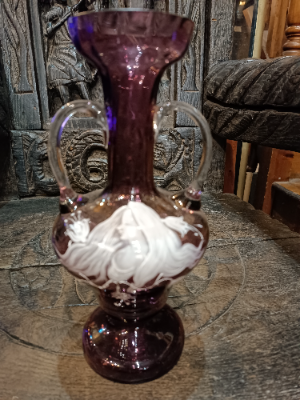
Product ID: 8808
A Mary Gregory Amethyst Vase With 2 Hand..., For Sale
Buy It Now: £50.00
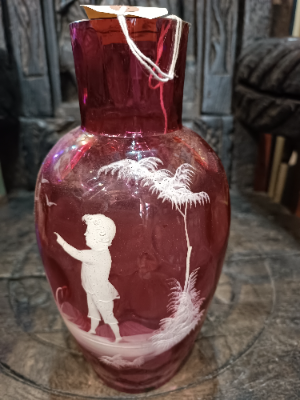
Product ID: 8807
A Large Mary Gregory Cranberry Glass Vas..., For Sale
Buy It Now: £45.00
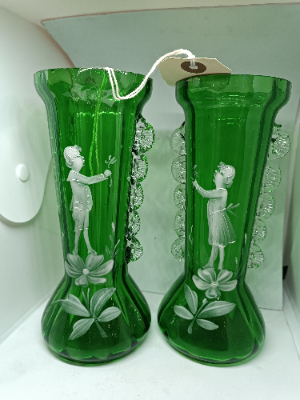
Product ID: 8806
A Pair Of Mary Gregory Green Vases, For Sale
Buy It Now: £30.00
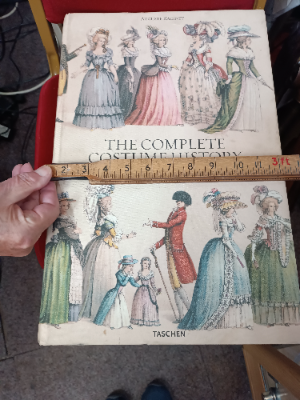
Product ID: 8805
A Very Large The Complete Costume Histor..., For Sale
Buy It Now: £300.00
Product ID: 8804
An Oil Painting Of Great Eastern Ship On..., For Sale
Buy It Now: £130.00
Product ID: 8803
A Medium Size Cast Iron Cauldron, For Sale
Buy It Now: £100.00