

ID: 2977
Harness Of Charles V Holy Roman Emperor
This item has been reserved.
Interior Decoration Generator
Use our AI-powered visualisation tool to see how furniture and décor could look in your home. Upload a photo of your room and the system will place the selected item into the scene.
Experiment with interior design ideas before making a decision and see how pieces may work with your room’s space, lighting, and style.
A free account is required so we can securely process your images and save your visualisations for later comparison.
Images are generated using AI and are intended as a visual guide only. Colours, proportions, and placement may not be perfectly accurate.
Login/Create a free account to continue

Choose Up To 4 Antiques
Select a type, period, and item for each slot. Your AJAX-loaded item preview appears immediately, and the full room renders below when the user clicks generate. This visualisation is generated using AI and is intended as a guide only. Placement, scale, and appearance may not be 100% accurate.

Description 🔉
About:
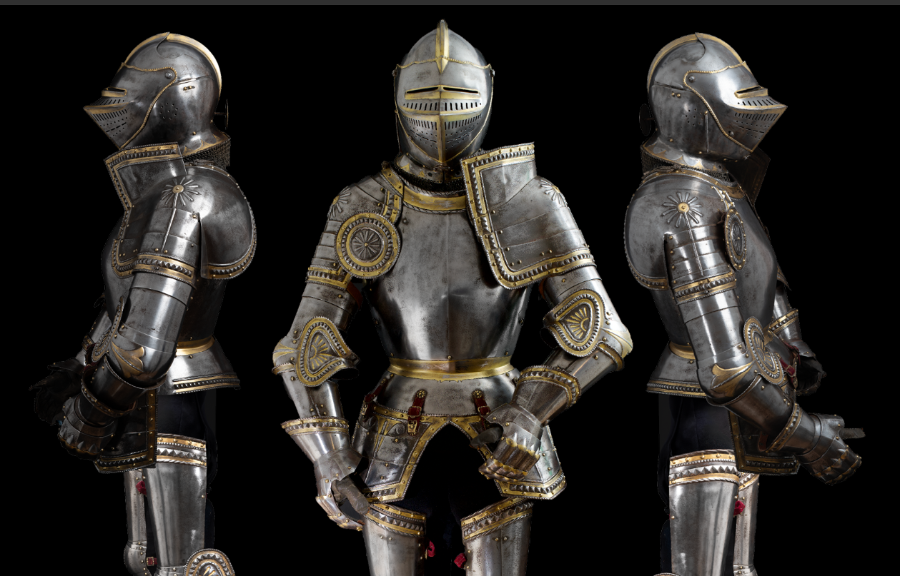
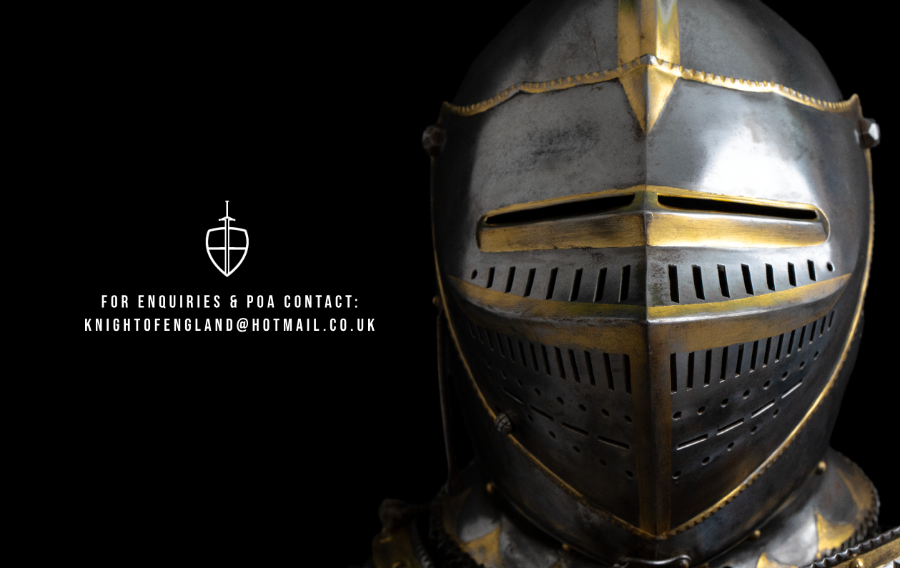
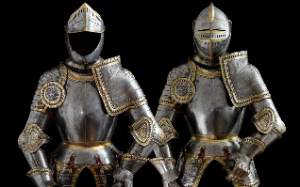
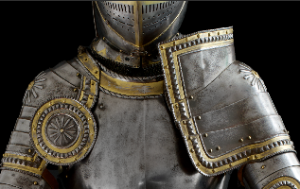
A fine decorative full field armor in the early 16th century style, inspired by the “KD Garniture” Harness of Charles V, forged by the Atelier of the Earl D’Asalto by Severino Consentino & Higinio Antonio Lorente, Toledo late 19th century to early 20th Century.
The original is attributed to Kolman Helmschmid of Augsburg, circa 1525, and displayed at the Royal Armoury of Madrid, It was created for Charles V, Holy Roman Emperor, King of Aragon, Castile, Naples, and Sicily, as well as ruler of territories in Burgundy (1500-1558).
Presenting a fine facsimilie this harness, designed for field or tournament use, stands as one of the finest and most elegant examples of 16th-century armor craftsmanship. Constructed as a complete harness with pieces of exchange (additional pieces that could replace or be added to the harness for different styles of combat), it is most commonly seen in the configuration presented here.
It is frequently referred to by one of two names: the "armour de bordes adiamantados" (armor with diamond-studded borders) or the "KD" Garniture. KD standing for " Karolus Divus"
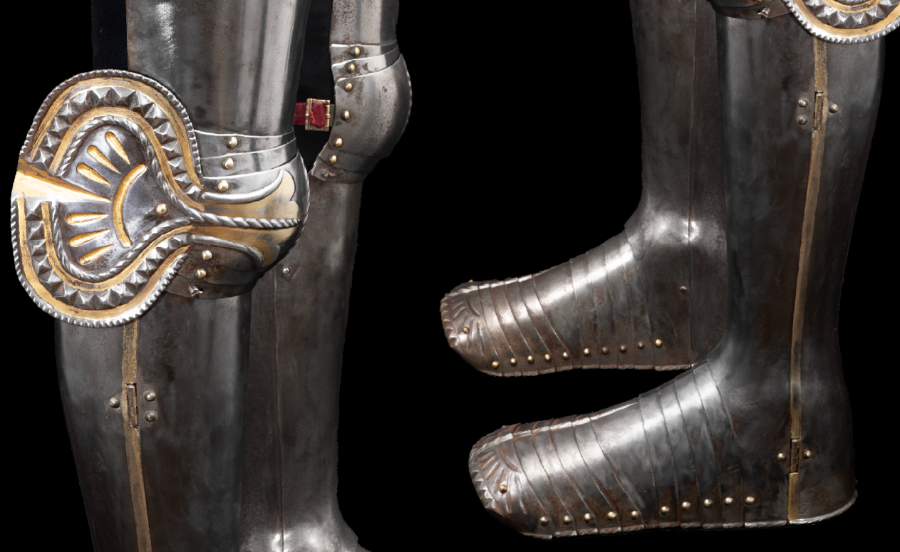
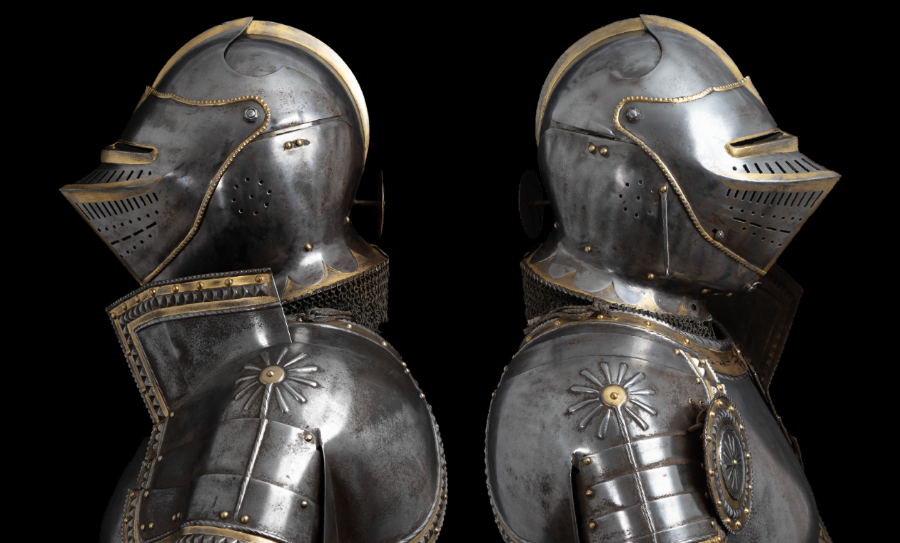
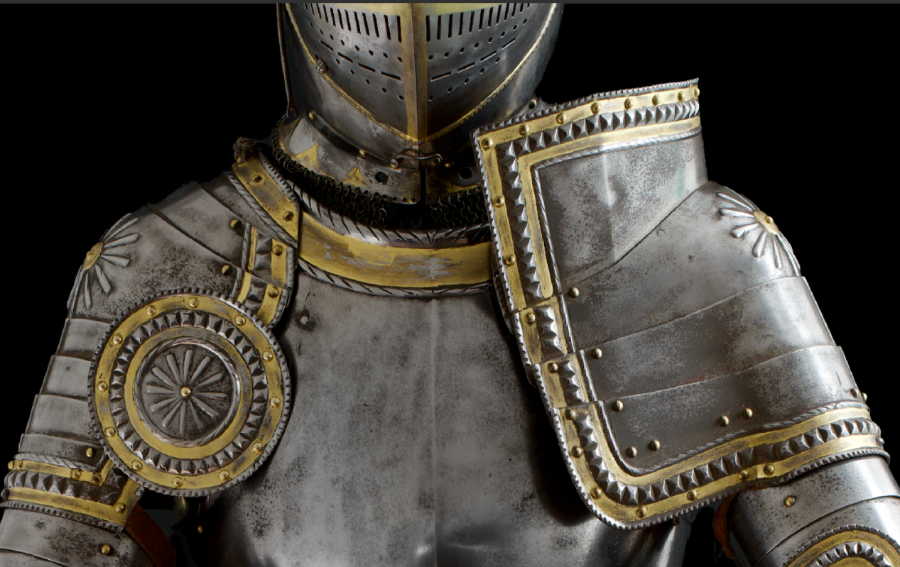
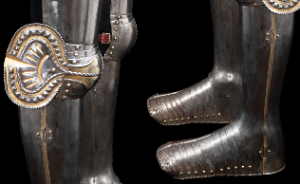
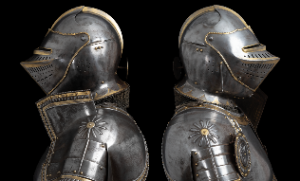
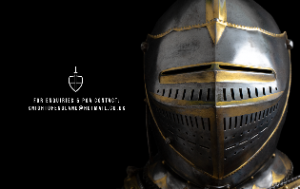
The armor comprises an armet, cuirass with tassets in the front and back, asymmetrical pauldrons, a besagew protecting the right armpit, vambraces, mitten gauntlets, cuisses, poleyns, greaves, and splayed-toed sabatons. The armet features a rondel at its back and is bordered at its base by a small skirt of mail.
Additionally, the armet includes a pierced, reinforcing browplate.
The original armor had a removable lance rest, which likely explains its absence in this rendition.
Armourer - Master of the Forge:
Little is known about the origin of Severino Consentino other than he was a master metal forger who operated toward the end of the 19th century.
Higinio Lorente Sánchez, born in Guadamur in 1898, apprenticed to Consentino at a very young age. His master, originally a coppersmith, forged harnesses, breastplates, and limbs, and also restored original armor. He worked exclusively for Spanish nobility, including Count D’asalto and Carlos Morenés, the Marquess of Borghetto.
This particular harness is presumed to be an example of their craftsmanship, possibly a rite of passage for the young Lorente, forged in the early 1900s.
The artisans likely had access to the original in Madrid, as it bears shapes consistent with hands-on experience rather than merely working from pictures. Minor details replicated from the early 20th century would have been impossible without constant comparison.
In 1921, Lorente became independent and set up his own workshop in Toledo, where he handcrafted and forged armor for over 60 years. Located on Calle del Santísimo Cristo de la Piedad, his workshop received numerous visits from journalists, who came to meet the last famous armor artisan.
The merit of his works lay in the fact that he made them with the same technique and mastery as his medieval counterparts: Italian, German, and Spanish artisans who forged armor for kings.
Higinio’s works adorn palaces and castles throughout Spain, France, Italy, Germany, and beyond. Some are even exhibited in museums, alongside original armor from the 16th century.
It is exceptionally rare in this modern day for known works to be available on the open market.
After 60 years of manipulating steel, Higinio’s strength failed him, and he passed away on January 29, 1991, at the age of 93.
His knowledge and techniques, learned over centuries, also died with him.
Field Armour made for Holy Roman Emperor Charles V
Charles V (24 February 1500 – 21 September 1558) served as Holy Roman Emperor and Archduke of Austria from 1519 to 1556, and as King of Spain from 1516 to 1556. He also held the title of Lord of the Netherlands as titular Duke of Burgundy from 1506 to 1555.
He was the heir to and the head of the rising House of Habsburg. His dominions in Europe included the Holy Roman Empire, extending from Germany to northern Italy, with rule over the Austrian hereditary lands and the Burgundian Low Countries.
In addition, he held sway over Spain and its possessions, including the southern Italian kingdoms of Naples, Sicily, and Sardinia. In the Americas, he oversaw the continuation of Spanish colonization and a short-lived German colonization.
The personal union of the European and American territories he ruled earned his realm the moniker “the empire on which the sun never sets,” with suns and rays featuring throughout the armor.
King of Aragon Castile,Naples and Sicily
Charles revitalized the medieval concept of universal monarchy.
Without a fixed capital, he embarked on 40 journeys through the various entities he ruled, spending a quarter of his reign traveling within his realms.
While his empire initially came to him peacefully, he spent most of his life engaged in warfare, depleting his revenues and accumulating debts in his effort to defend the integrity of the Holy Roman Empire from the Reformation, the expansion of the Ottoman Empire, and conflicts with France.
Charles borrowed money from German and Italian bankers and, to repay them, relied on the wealth of the Low Countries and the flow of silver from New Spain and Peru, acquired under his rule following the Spanish conquest of the Aztec and Inca empires, which led to widespread inflation.
He died at 58 from malaria, leaving his heirs in significant debt from his years of warfare.
Provenance:
This harness in its entirity came from a collector in Japan who initially purchased it twenty years ago in Germany where it is purported to have come from a relative of the deceased estate of Eberhard von Stohrer, a German career soldier during the war and a diplomat to Spain living in Madrid. It underwent some minor professional restoration recently involving some polishing and regilding.
The style of work has been identified by Dr Nicholas Phillipe Baptiste, a Belgian Doctor in Medieval History, Exhibition Curator, accomplished author from the University of Savoie and a specialist in arms and armour from the past to the current day.
Baptiste immediately recognised the style, construction and compositon as the work of Lorente and potentially another, this with its potential origins in Madrid reinforced the story of this incredible garniture.
Seller Details
VISIT SELLERS SHOP- Business Name: Knight of England
- Name: David
- Email: Knightofengland@hotmail.co.uk
- Phone: 01522 545916
- Address:
- 64-65 Steep Hill, Lincoln, Lincolnshire, United Kingdom.
- LN21LR
- Interested in Seeing Other Antique Shops Nearby?
- Note:
- An enthusiast and antiques collector with a passion for all things history related!
Legal Note
For antique firearms such as muskets and rifles, this item is offered strictly as a collectors’ piece. It is sold as a historic firearm for display or study purposes only, and not as a modern, live-firing weapon. Export, import, and ownership regulations vary by country; buyers are responsible for ensuring compliance with their local laws and confirming that they are not prohibited from ownership. In accordance with UK guidelines, the seller is required to verify the buyer’s identification and age prior to completion of the sale. By purchasing antique weapons, the buyer is also consenting that they are not on a prohibited person register.